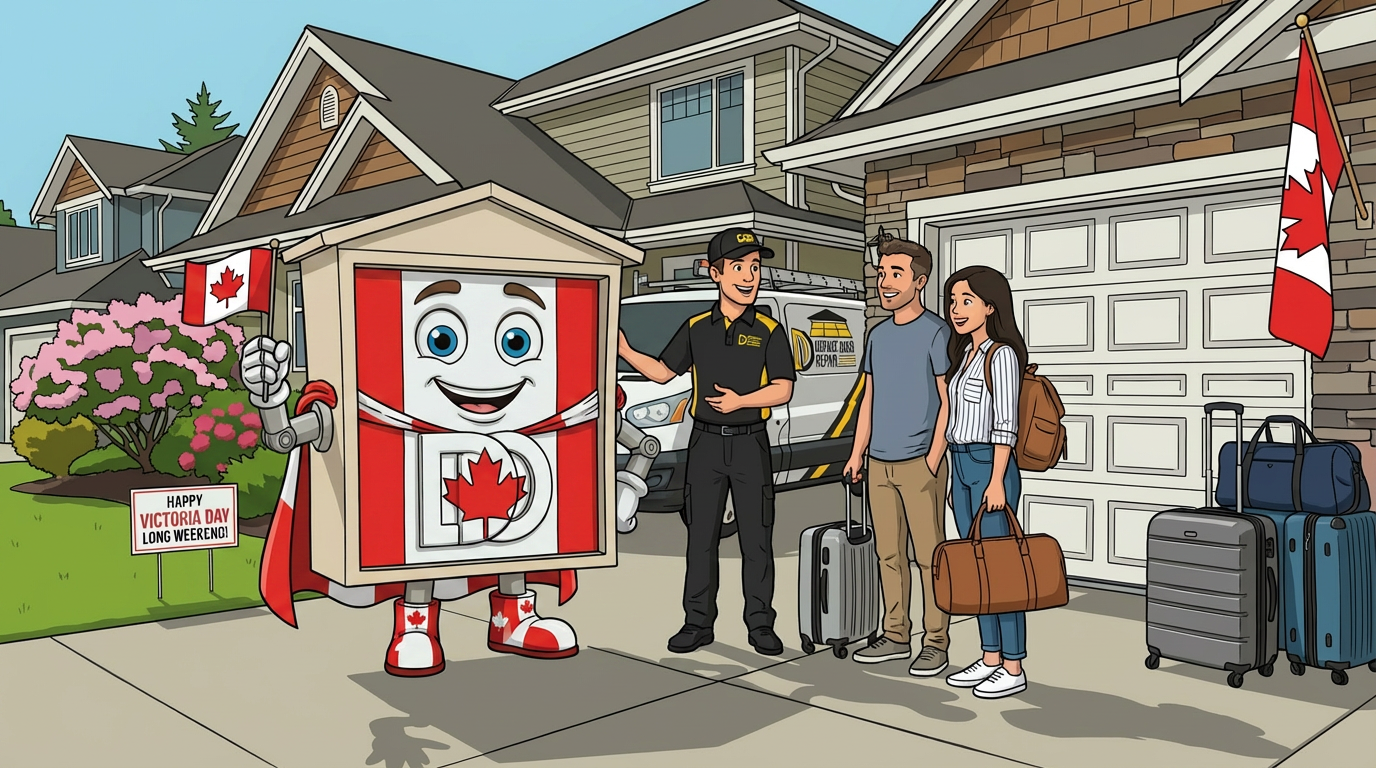
The Victoria Day long weekend is the unofficial start of summer in Maple Ridge, and for a lot of families it’s also the first big road trip of the year — up to Harrison, over to Manning Park, out to the Okanagan, or up to a cabin somewhere on the coast. Before you pack the car, spend ten minutes on your garage. It’s the most commonly overlooked entry point in a typical home, and burglars who target empty houses over long weekends know it.
This post walks through a short pre-trip security checklist specifically for garage doors — the vulnerabilities most Maple Ridge homeowners miss, the quick fixes that take no tools, and what to do if you’ll be gone for more than a few days.
Why Garages Get Targeted Over Long Weekends
A few things make the garage the preferred entry point for opportunistic break-ins:
- Older openers are hackable. Any opener manufactured before 2011 that uses a fixed code (rather than a rolling code) can be defeated by a commercially available “code grabber” in under 30 seconds. If your opener is more than 15 years old, assume this applies.
- The emergency release cord. The red cord hanging from your opener can be triggered from outside through the gap at the top of the door using a bent coat hanger. This is a well-known technique.
- Visible absence signals. An empty driveway, no lights, and no activity all weekend tells anyone watching that the house is unattended. The garage is the quietest way in.
- Homes in Albion, Silver Valley, and parts of Hammond back onto greenbelts and trails, which give attackers cover. Great for privacy; not great when you’re away.
None of this is meant to scare you — garage break-ins are still rare. But the fixes below are genuinely quick and eliminate the easy targets.
The 10-Minute Pre-Trip Checklist
1. Close the Door (Obvious, But Checked Last)
Before you back out of the driveway, confirm the door is fully closed. The most common “break-in” we hear about over long weekends is actually “someone walked into an unlocked, open garage.” If you have a smart opener, check the app from the driveway, not from memory. If you don’t have a smart opener, visually confirm.
2. Engage the Manual Lock (If You Have One)
Most sectional garage doors have a manual slide lock or a T-handle lock on the inside of the door. Once the door is closed, slide the bolt into the track or engage the T-handle. This physically prevents the door from being opened even if someone disengages the opener.
If your door doesn’t have a manual lock, or it’s been disabled (some installers remove them during opener installs to prevent accidents), a $25 aftermarket slide bolt solves this.
3. Cover or Block the Emergency Release
The red release cord is the single biggest garage vulnerability. Block it with a zip tie or a commercial “garage shield” device that covers the latch. There are also ways to thread a zip tie through the release mechanism that prevents the cord from pulling the trolley free. A technician can do this in 5 minutes if you’re not comfortable with it.
For people going away for a week or more, this is non-negotiable. A coat hanger attack on an unshielded release takes under a minute to execute.
4. Unplug the Opener Entirely (For Longer Trips)
If you’ll be gone for more than 3 days and your door is manually locked, consider unplugging the opener from the wall outlet. Disconnecting power means a code grabber has nothing to work with, and since the door is already manually locked, you don’t need the opener to be functional anyway. Just remember to plug it back in when you get home.
5. Check for Gaps and Visible Sightlines
Walk around the outside of your garage door. Can you see into the garage through the side gaps, the top header, or under the bottom? Burglars scout houses before they break in. If they can see an empty space inside, that’s an invitation.
Close any gaps with new weatherstripping (covered in detail in our Coquitlam waterproofing post) or temporarily hang something in front of the side windows if your door has them.
6. Secure the Garage-to-House Door
This is the door that leads from the garage into your home. In a surprising number of homes, it’s an unlocked hollow-core interior door — which is to say, no security at all. If an attacker gets into the garage, this door is the next step into your house.
Minimum: lock it. Better: install a deadbolt and use a solid-core door. This matters even more when you’re away.
7. Put Lights on Timers
Exterior garage lights on a timer (or motion sensor) deter anyone watching the house at night. If you have smart lights or a smart plug, use a randomized schedule — not “on at 7, off at 11” every day.
8. Turn Off the Wi-Fi Opener App Notifications? (Or Leave Them On)
If you have a smart opener with notifications, leave them on. You want to know immediately if the door opens while you’re away. The flip side: if the app pings you constantly about non-events, the notifications lose value. Check the settings before you leave so you’re only notified for actual opens and closes.
9. Don’t Announce You’re Away on Social Media
Old advice, still true. “Heading up to Harrison for the long weekend!” is a public announcement that your house is empty. Save the photos for when you’re back.
10. Tell One Trusted Neighbour
One person. Someone who can glance over once a day and text you if anything looks wrong. They don’t need to do anything — just be eyes. Most Maple Ridge neighbourhoods are the kind of place where this is a five-minute conversation.
Checklist Reference Card
| Task | Time | For trips of… |
|---|---|---|
| Close door and confirm | 10 sec | Any |
| Engage manual lock | 30 sec | Overnight+ |
| Block emergency release | 2 min | 2+ days |
| Unplug opener | 1 min | 3+ days |
| Lock garage-to-house door | 30 sec | Any |
| Timer-controlled lights | Set once | 2+ days |
| Confirm smart app notifications | 1 min | Any |
| Notify neighbour | 5 min | 3+ days |
What NOT to Do
A few common “security measures” that actually don’t help:
- Don’t leave the garage lights on 24/7. It’s a dead giveaway that nobody is home and nobody is touching the light switch.
- Don’t put a note on the door saying when you’ll be back. Yes, people still do this.
- Don’t hide a spare key in the garage. If someone gets in, now they have keys to everything.
- Don’t rely on a smart doorbell alone. Doorbells watch the front door, not the garage. They’re a great layer, not a replacement for the actual steps above.
If You’ve Just Installed a New Opener
If your opener was installed in the last few years, you already have two big advantages: rolling codes (which can’t be easily captured and replayed) and encryption on the remote signal. You can skip Step 4 (unplugging) with more confidence, though the other steps still apply.
If your opener is pre-2011 or you’re not sure, assume worst case and unplug it before long trips.
Bottom Line
Ten minutes of pre-trip prep is cheap insurance. Engage the manual lock, block the emergency release, lock the interior door, and tell a neighbour. Most Maple Ridge homes are in genuinely safe neighbourhoods, but the few break-ins that happen over long weekends almost always use the garage as the entry point — and they’re almost all preventable.
If your door doesn’t have a working manual lock, if your emergency release isn’t shielded, or if your opener is 15+ years old, we can fix all three in a single short visit. We handle garage door opener upgrades and garage door maintenance across Maple Ridge, Pitt Meadows, and the eastern Fraser Valley. Book a pre-trip tune-up and we’ll get it handled before the weekend.