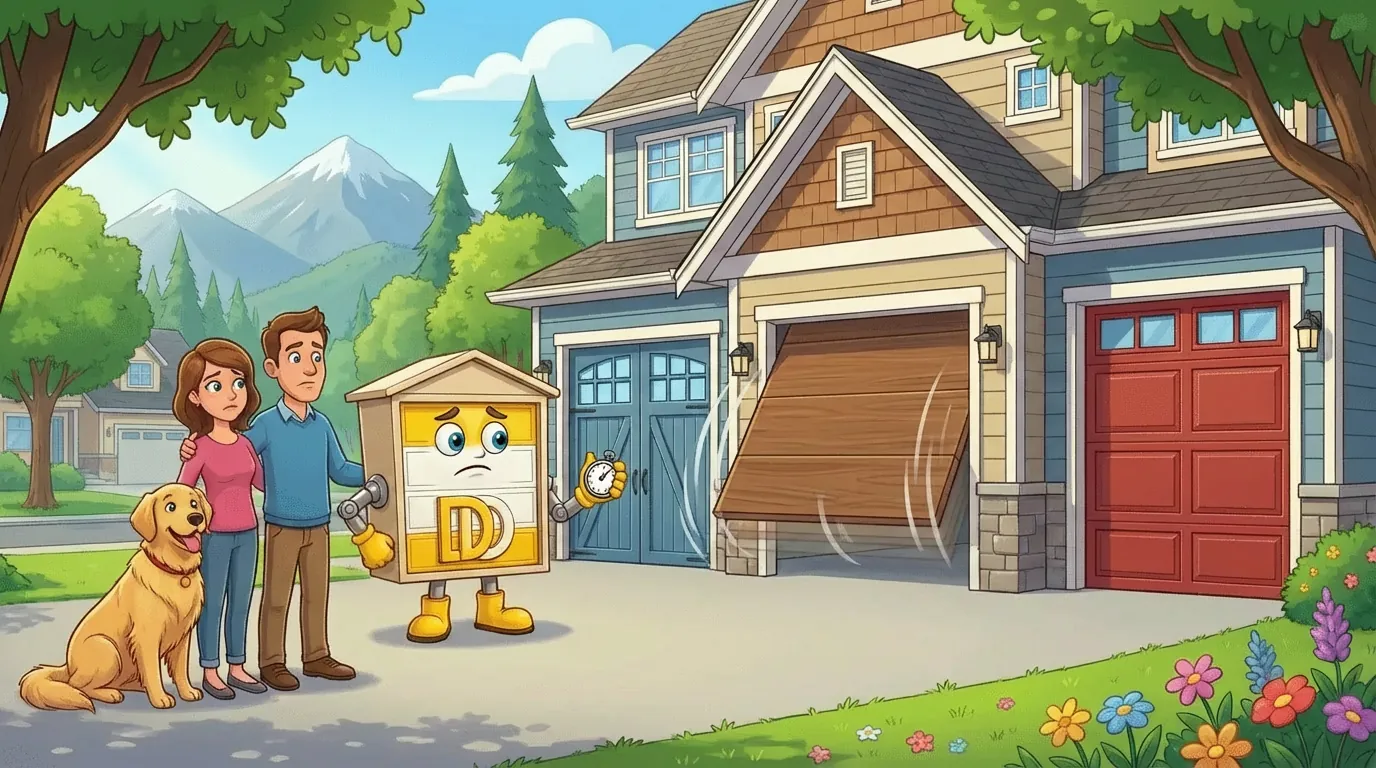
Your garage door opens at normal speed. But closing? It crawls. Sometimes it stops mid-travel. Sometimes it makes it all the way down but feels like it is hesitating the whole way.
If this sounds familiar, you have one of four problems. Three are cheap mechanical fixes. One is a wear-related failure that needs attention before it becomes an emergency.
Here is the important part: a door that closes too slowly is a bigger problem than a door that opens too slowly. Opening slowly is annoying. Closing slowly is usually a symptom of a spring or cable on its way out, which is a safety issue.
This guide walks through the four most common causes, in the order that gets you to the fix fastest.
Why Doors Open Faster Than They Close by Design
First, a quick reality check: garage doors are SUPPOSED to open slightly faster than they close. The close cycle is intentionally slower for safety reasons.
Normal residential speeds:
- Open cycle: 7 to 10 inches per second
- Close cycle: 6 to 8 inches per second
- Total cycle time: 12 to 16 seconds for a 7-foot door
If your door’s close speed is 20 to 30% slower than its open speed, that is within normal range. If it is half the speed or slower, or if it stops mid-close, that is not by design; that is a problem.
The 4 Most Common Causes
| # | Cause | Likelihood | Typical fix | DIY? |
|---|---|---|---|---|
| 1 | Spring tension weakening | Very common | Spring adjustment or replacement | Technician |
| 2 | Worn cables | Common | Cable replacement | Technician |
| 3 | Track or roller friction | Common | Cleaning, lubrication, roller swap | Yes |
| 4 | Opener close-force setting | Occasional | Adjust close-force screw | Yes |
Start with the DIY checks (rows 3 and 4) first. They take 20 minutes and cost nothing. If those do not resolve it, rows 1 and 2 are technician territory.
Cause #1: Spring Tension Weakening
The torsion spring above your garage door is what actually lifts the door’s weight. The opener motor just provides direction and timing. A properly tensioned spring makes the opener’s job easy. A fading spring forces the opener to do work it was never designed for.
How to identify it
- The door drops quickly past the halfway point while closing
- The door opens normally but closing feels “heavy”
- You can hear the opener motor straining on the close cycle
- Manual balance test fails - door drops hard when released at chest height
Why it happens
Torsion springs are rated for cycles, not years. A standard residential spring is rated for 10,000 cycles, about 7 to 10 years of typical use. In Maple Ridge homes built in the early 2000s, most original springs are well past that life.
Heads up: this is NOT a DIY fix. Torsion springs store enormous energy and require specialized tools to safely adjust or replace. Even a partial failure of an old spring during DIY repair has caused serious injuries.
A professional spring replacement in Maple Ridge runs $180 to $350 for a single-spring door, $300 to $500 for a dual-spring setup. Most jobs are 45 to 60 minutes on site.
Cause #2: Worn Cables
The two lift cables on each side of the door are what the spring actually pulls on. As they wear from daily cycling, occasional kinking, and BC humidity, they stretch, fray, and eventually snap.
How to identify it
With the door closed and the opener disconnected, look at each lift cable.
- Cable is taut and evenly wound on the drum at each end - good
- Cable has visible fraying or broken strands - replace immediately
- Cable looks unevenly wound or has loose loops - replace immediately
- One cable looks longer than the other - stretched, replace both
Why it matters
A cable failure during a close cycle causes the door to fall on one side, twist, and typically damage at least one panel. It is an immediate safety hazard.
Cable replacement is $150 to $300 depending on whether one or both cables are replaced, and whether the drum or spring also need attention. Always replace cables in pairs even if only one is visibly worn.
Cause #3: Track or Roller Friction
This is the DIY-friendly cause. If your door has been noisy, squeaky, or sticky-feeling for a while, friction may be the whole problem.
How to identify it
Disconnect the opener and try lifting the door by hand.
- Lifts smoothly with moderate effort - friction is fine, look at springs or cables
- Feels sticky or catchy at specific points - track friction at that point
- Requires a lot of effort to lift at all - multiple issues, probably spring plus friction
DIY fixes
Run through these in order:
- Wipe down the tracks with a clean dry rag (remove dirt, debris, spider webs)
- Inspect rollers for flat spots, wobble, or seized bearings (replace if worn - see our roller replacement guide)
- Lubricate hinges, roller shafts, and bearing plates with silicone spray and a thin film of white lithium grease on the bearing plates
- Check for track deflection by standing back and looking down each track for obvious bends or misalignment
Most friction problems resolve with a full lubrication pass and a roller check. Takes 20 minutes if you already have silicone spray on hand.
Cause #4: Opener Close-Force Setting
If the opener’s close-force is set too sensitive, the motor backs off or stops when it encounters even minor resistance (a slight track hiccup, a bit of friction on a wet morning).
How to identify it
- The door closes slowly on some days and normally on others
- The pattern correlates with temperature, humidity, or time of day
- The door sometimes reverses during the close cycle
- Close speed feels “tentative” throughout, not just near the floor
DIY fix
Most openers have a small adjustment screw on the back labeled “Close Force” or “Down Force.”
- Turn the screw clockwise a quarter-turn to increase close force
- Run a full close cycle and observe
- Repeat in quarter-turns if the door still closes hesitantly
Heads up: do not turn the close-force all the way up to compensate for a real mechanical problem. If the door closes smoothly at the new setting but you had to make a large adjustment, the underlying cause is probably friction or spring tension, not the force setting. Fix the real problem instead of masking it.
Diagnostic Reference for Maple Ridge Homeowners
| Symptom | Most likely cause | DIY? |
|---|---|---|
| Door drops fast past halfway | Weak spring | Technician |
| Cable looks frayed | Cable wear | Technician |
| Opener motor strains on close | Spring or friction | Partial |
| Sticky feeling at specific points | Track or roller friction | Yes |
| Hesitant close on some days only | Close-force setting | Yes |
| Door stops mid-close and reverses | Photo-eye or obstruction | Yes |
Maple Ridge Specifics
A lot of Maple Ridge housing stock was built in the 1990s and early 2000s. That means a lot of original springs from that era are now 20 to 25 years old, well past their rated life.
Signs your spring is on its way out:
- Original installation from before 2005
- You hear a “pop” sound when the door operates
- Manual balance test fails (door drops hard at chest height)
- Gap of any size visible in the spring coil
If any of those are true, have the spring inspected this year, not next. Spring failure on an unbalanced door can damage the panels, bend the tracks, or snap a cable on the way out, turning a $250 spring job into a $1,200 door overhaul.
When to Call vs. DIY
DIY if:
- The close issue correlates with weather or humidity (force-setting problem)
- You can feel friction when manually lifting the door
- Rollers show visible wear
- Lubrication has not been done in a year or more
Call a technician if:
- The door drops hard past halfway
- You see spring coil gaps or cable fraying
- The opener motor sounds strained under load
- Your door is 15+ years old and has never had a spring service
We handle garage door repair and spring and cable repair across Maple Ridge and the rest of the Fraser Valley, usually same-day for standard calls.
Bottom Line
A garage door that closes noticeably slower than it opens has four common causes. Two are DIY (friction, close-force) and two need a professional (spring tension, cable wear).
Your diagnostic path:
- Check if the symptom correlates with weather (force-setting issue)
- Run a manual balance test (spring tension check)
- Inspect cables for fraying
- Try a full lubrication pass and roller inspection (friction fix)
- If DIY steps do not resolve it, call for a professional assessment
If the door is 15+ years old, or any balance or cable check raises concerns, book a service visit. The cost of a spring or cable job before failure is a fraction of the cost after.