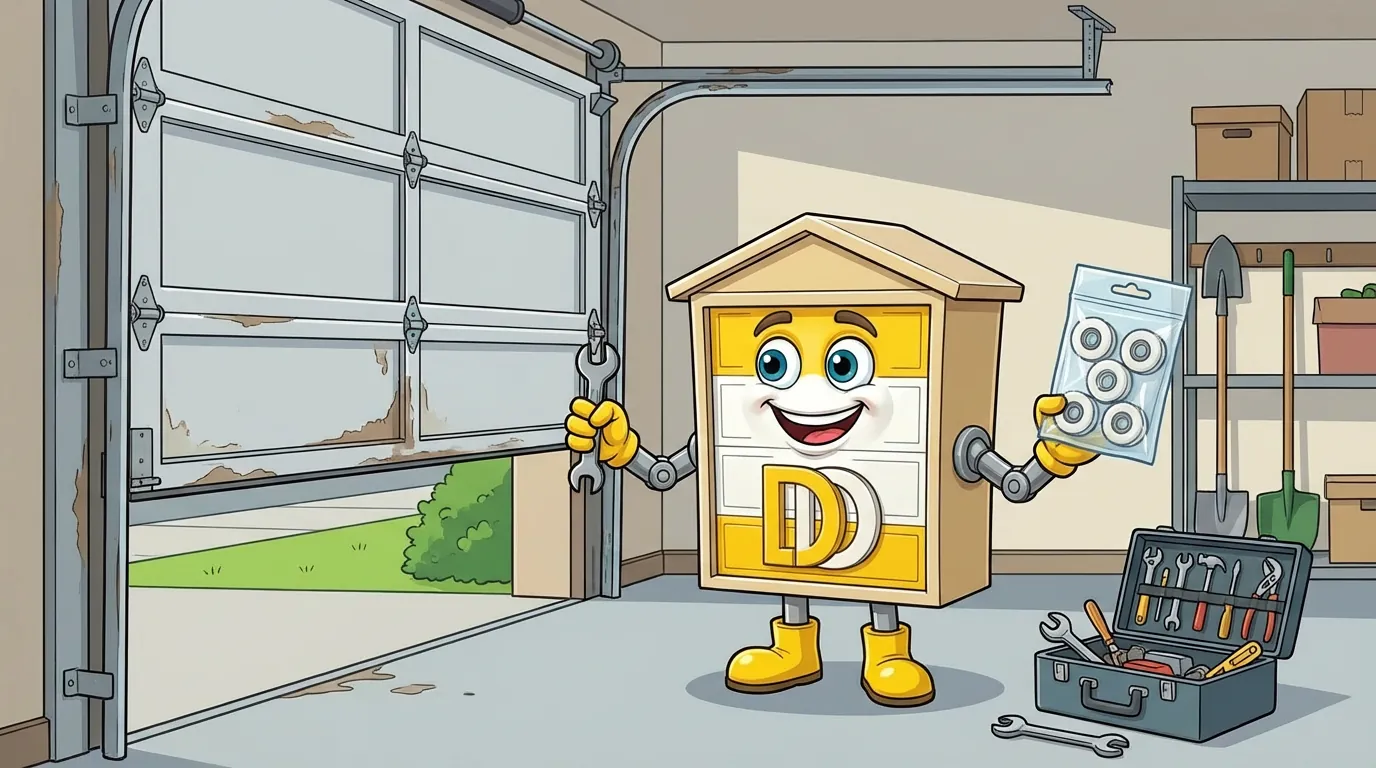
Your garage door sounds like a freight train. Every open and close, a grinding rattle echoes through the house.
Nine times out of ten, it is the rollers. And in Surrey homes built before 2010, it is almost always the rollers.
The good news: this is one of the few garage door repairs a confident DIY homeowner can tackle safely. Total cost: $30 to $80 in parts. Total time: 45 to 60 minutes. No specialized tools.
The catch: you MUST know how to do it without touching the springs, because that is where DIY roller jobs become emergency room visits.
This guide covers:
- How to tell if your rollers are worn (vs. some other problem)
- Which replacement rollers to buy (and which ones to skip)
- The tools you need (everything under $40)
- Step-by-step replacement without touching the spring
- When to stop and call a technician
How to Tell If Your Rollers Are Worn
Rollers wear predictably. Here is what to look for, from most obvious to most subtle.
Listen first
Open and close the door once, standing inside the garage.
- Grinding or scraping sound - worn rollers are the #1 cause
- Rattling metal - usually worn steel rollers
- Squeaking - often dry rollers that need lubrication first, not replacement
- Thumping at specific points - could be flat-spotted rollers OR a track issue
If the noise is consistent throughout the door’s travel, it is almost certainly rollers. If it happens at one specific point each time, it may be a track dent instead (which a DIY roller swap will not fix).
Look at each roller
With the door closed, examine each roller where it meets the track. You are looking for:
- Flat spots on the nylon wheel face (the wheel cannot rotate smoothly)
- Missing material on the wheel (chunks broken off, especially on steel rollers)
- Visible wobble when you gently push the roller sideways (worn shaft or bearing)
- Rust on the roller shaft (bearing is failing)
- Black rubber residue on the track (wheel has been dragging, not rolling)
Any one of those equals replacement time. If you see multiple signs on multiple rollers, replace the entire set.
The spin test
Disconnect the opener. Lift the door to about chest height. Spin each roller with your finger.
- Spins freely for 2-3 seconds - roller is fine
- Stops after half a turn - bearing is gummy or failing
- Does not spin at all - bearing is seized, replace immediately
- Wobbles as it spins - shaft is worn, replace
Which Rollers to Buy
Standard residential garage doors use one of three roller types.
| Type | Wheel material | Bearing | Cost per roller | Typical life | Noise |
|---|---|---|---|---|---|
| Basic steel | Steel | None | $2-$5 | 7-10 years | Loud |
| Standard nylon | Nylon plastic | 6-10 ball bearings | $5-$10 | 15-20 years | Quiet |
| Premium nylon | Nylon plastic | 10-13 ball bearings | $10-$18 | 20-25 years | Very quiet |
If you are replacing rollers in a Surrey home: go straight to premium nylon with 10 to 13 bearings. The cost difference across a full door (10 rollers) is $60 vs $150. The life difference is 10 to 15 years. It is not close.
Match your door size
A standard residential door uses 10 rollers (2 at the bottom, 4 on each side). A larger double-car door may use 12. Some low-headroom installations use 10 standard plus 2 short-stem.
Check your existing rollers:
- Shaft length (measure from the inside of the bracket to the wheel face)
- Stem vs. fixed shaft (most residential is stem-mounted; commercial is often fixed)
- Wheel diameter (2 inches is standard residential; 3 inches is common commercial)
The local Surrey hardware stores stock the standard 10-bearing nylon rollers for residential doors. Premium 13-bearing rollers are usually a special order or online purchase.
Tools You Need
- Adjustable wrench or 7/16” socket wrench
- Flat-head screwdriver (for prying out old rollers)
- Work gloves
- Flashlight or headlamp
- Step stool or small ladder
- A partner (strongly recommended for the top rollers)
Total cost if you need to buy everything: $30 to $40. You probably already have most of it.
The Step-by-Step Replacement
This is the version that keeps you away from the spring. Read the whole sequence before starting.
Step 1: Close the door and disconnect the opener
- Close the door all the way
- Pull the red emergency release cord (disconnects the opener from the door)
- Verify the door stays closed when you let go of the cord
- Unplug the opener from the ceiling outlet (belt and suspenders, no surprises)
Stop here if: the door tries to roll up on its own when you pull the emergency release. That means the springs are OVER-tensioned and the roller job becomes technician territory. Reconnect and call.
Step 2: Replace the middle and top rollers first
These are the safest to replace because the spring is not actively loaded on them when the door is closed.
For each middle or top roller:
- Find the hinge bracket holding the roller in place
- Loosen the bolts on that hinge just enough to slide the roller stem free of the track
- Pull the old roller out of the bracket (might need a flat-head screwdriver to pry)
- Slide the new roller into the bracket
- Feed the stem back into the track
- Re-tighten the hinge bolts
Repeat for every roller ABOVE the bottom hinge. Do not touch the bottom brackets yet.
Step 3: The bottom rollers require caution
The bottom bracket on each side is attached to the cable that holds the door’s weight under spring tension. You CANNOT unbolt the bottom bracket without triggering the spring.
What you CAN do:
- Replace bottom rollers by flexing the track slightly outward with a flat-head screwdriver (NOT the bracket)
- Slide the old roller out through the gap
- Slide the new roller in
- Gently bend the track back into position
What you CANNOT do:
- Unbolt the bottom bracket
- Loosen the cable attachment
- Touch the spring or adjust tension
If the bottom rollers cannot be swapped via the flex-the-track method on your specific door, stop. Leave the bottom rollers alone and have a technician do them during your next service visit. Replacing 8 of 10 rollers still makes a huge difference.
Step 4: Test before re-connecting
With the opener still disconnected:
- Lift the door by hand about 2 feet
- Let go
A balanced, well-rollered door should stay in place or drift very slightly. If it drops hard or shoots up, spring tension is off (unrelated to your roller job, but worth noting).
- Lift all the way up, then lower it slowly
- Listen for any new noises (there should not be any)
Step 5: Re-connect the opener
- Plug the opener back in
- Pull the emergency release cord toward the door (re-engages the carriage)
- Operate the door once from the wall button
- Listen
If the door now runs whisper-quiet, you did it right.
When to Stop and Call a Technician
Stop the DIY job if:
- The door tries to roll up when you pull the emergency release (over-tensioned spring)
- Bottom rollers cannot be swapped without unbolting the bracket
- You see a broken or visibly damaged spring coil
- Cables are frayed, loose, or broken
- The track itself is bent or damaged
- You get to Step 3 and it just does not feel safe
A residential roller replacement by a professional runs $100 to $180 for all 10 rollers including premium nylon and labour. If you are at all uncertain, that is a reasonable alternative to a DIY job gone wrong.
We handle garage door maintenance and roller replacement across Surrey and the rest of the Lower Mainland, usually same-day for standard calls.
Bottom Line
Worn rollers are the #1 reason Surrey garage doors get loud. Replacing them is one of the few door repairs a confident DIY homeowner can do safely, as long as you stay out of the bottom bracket and never touch the springs.
Your DIY checklist:
- Confirm the noise is rollers (listen, look, spin test)
- Buy 10 premium 13-bearing nylon rollers ($100 to $150 total)
- Set aside 45 to 60 minutes on a weekend morning
- Close the door, disconnect the opener, pull the plug
- Replace middle and top rollers first
- Swap bottom rollers by flexing the track (or leave them for a pro)
- Test by hand, then re-connect the opener
If the DIY route is not for you, book a service call and we will swap the whole set and give you a quieter door than you have had in 15 years.