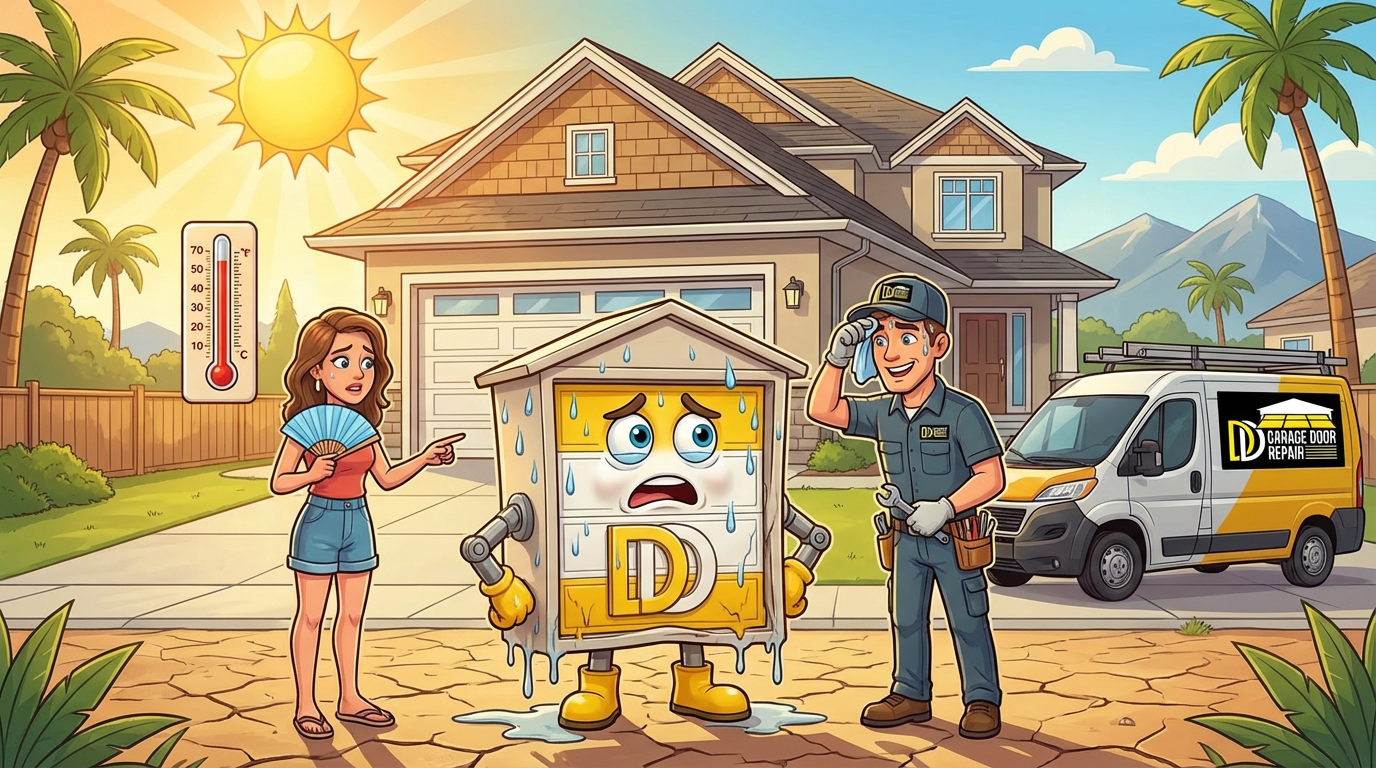
West Vancouver summers are no longer the mild, cool weeks they used to be. Recent years have delivered extended stretches above 28°C in Ambleside, Dundarave, and along the Upper Levels corridor, with south-facing homes on the lower slopes getting full afternoon sun from 1 PM until well past dinner. That kind of heat is tougher on garage doors than most homeowners realize — especially on the metal, the lubricants, the electronics, and the weather seals that keep the door operating smoothly.
This post walks through what summer heat actually does to a garage door, the specific failures we see in West Vancouver homes each year, and what to do now to prepare before the first heat wave hits.
Why Summer Heat Is a Problem for Garage Doors
Cold weather gets a lot of attention for garage door problems, but heat causes its own set of specific failures. A few physical things happen to a closed door under direct summer sun:
- The metal panels expand. Steel and aluminum both grow slightly with temperature. On a 16-foot double door in full sun, the door can expand 2–3 mm across its width — enough to change how it sits in the tracks and how the rollers move.
- Lubricant viscosity drops. Hot lubricant runs thinner and can drip or wash off. By August, doors that were perfectly lubricated in April can be running dry on the hottest components.
- Rubber seals soften and deform. The bottom astragal and side weatherstripping temporarily lose shape under heat and can stick to the concrete or the jamb, then pull away when the door opens.
- Opener electronics get hot. Garage openers are not rated for extreme heat. On south-facing garages that act like ovens in August, the opener’s logic board and capacitors can overheat and trigger safety shutdowns.
- Photo eye sensors can get misaligned. The mounting brackets on older photo eyes can soften slightly in heat, causing the sensors to drift out of alignment.
None of these are catastrophic on their own. Together, they make summer one of the more demanding seasons for a garage door — especially in a hot microclimate like the south-facing slopes of West Vancouver.
Symptoms West Vancouver Homeowners Report in Summer
On service calls during hot weeks, we see a consistent pattern of heat-related failures. The most common symptoms:
- Door sticks at the top when opening. Panel expansion has shifted the fit. Usually self-corrects as the door heats evenly.
- Door won’t fully close. Heat has moved a photo eye, or the bottom seal has deformed and is triggering the obstruction sensor.
- Opener randomly stops mid-cycle. Thermal shutdown on an overheating motor or logic board.
- Louder than usual operation. Lubricant has run thin, rollers and bearings are running drier.
- Visible rust bloom on springs. Dry springs picking up moisture overnight from dew, then heating and oxidizing.
- Weather seal sticks to concrete. Rubber has softened and effectively glued itself to the floor overnight.
- Remote range has dropped dramatically. High ambient heat affects both the transmitter and the receiver.
If you’re already seeing any of these, don’t wait for full failure — fix them before the heat gets worse.
The Pre-Heat-Wave Checklist
1. Re-Lubricate for Summer
The lubricant you applied in spring may already be thinning out. For summer specifically, use a white lithium grease or a high-viscosity garage door lubricant — not a light silicone spray, which runs too thin in heat. Focus on the torsion spring, hinges, and roller bearings.
A 15-minute re-lubrication in late May or early June can solve half the noise-and-stiction complaints we get in July.
2. Test the Photo Eye Alignment
Bright summer sun can create issues for photo eye sensors in two ways: direct sunlight shining into the lens can cause false triggers, and thermal expansion of mounting brackets can shift the alignment over weeks. Confirm both sensors are square-on to each other, lenses are clean, and you don’t see a blinking error light.
3. Check the Weather Seal
Close the door and look at the bottom astragal seal. If it’s soft, deformed, or peeling, this is the time to replace it — before it sticks to the concrete on a hot morning and tears when you open the door. New seals cost $30–$60 and slide into the existing retainer.
Side weatherstripping along the jamb should also be checked. If it’s cracked or gapping, replace it now, not in August.
4. Give the Opener Ventilation
If your garage door opener is located in a spot that gets direct sunlight through a skylight, or if the garage itself hits 35°C+ during peak afternoon, consider running a small fan during hot days to keep air moving around the opener. This sounds silly but reduces thermal shutdown trips meaningfully.
For long-term situations, some homeowners install a small ceiling vent fan tied to a thermostat — pricey but effective.
5. Watch the Door’s Colour
West Vancouver design-conscious homes often have dark-coloured garage doors — black, dark grey, charcoal. Those absorb significantly more heat than light colours. A black steel door in direct afternoon sun can reach 70°C surface temperature. That’s hard on the paint, the foam core, and any nearby rubber components.
If you’re planning a door replacement and your garage faces south or west, factor colour into your decision. A lighter shade or a heat-reflective finish can add years to the door’s life in a hot exposure.
6. Check the Manual Balance
Heat expansion and lubricant changes can subtly affect door balance. A 2-minute manual balance test (disconnect opener, lift to waist height, let go) will reveal whether the spring is still doing its job. A door that drifts strongly in one direction needs a spring adjustment — don’t wait for it to fail.
Heat Effects by Component
| Component | Summer failure mode | Prevention |
|---|---|---|
| Torsion spring | Dry running, accelerated wear | Re-lubricate for summer |
| Rollers and bearings | Lubricant thinning, noise | Use high-viscosity grease |
| Panels | Expansion, alignment shift | No fix needed; self-corrects |
| Bottom seal | Softening, sticking | Replace before summer |
| Photo eye | Alignment drift, false triggers | Re-align and clean |
| Opener motor | Thermal shutdown | Ventilation and airflow |
| Paint finish | UV fade and heat damage | Lighter colours for new doors |
When to Call a Professional
Most of the summer prep above is DIY-friendly. Call for service if:
- The door has stopped working entirely in hot weather (opener thermal shutdown is the usual cause, but needs diagnosis)
- You see visible warping or panel damage
- The photo eye won’t stay aligned after cleaning
- The spring fails the balance test
- Any unusual new sounds after hot days
Summer service calls spike in the Lower Mainland during heat waves, so booking early — mid-June, before the hottest weeks — means faster response.
Bottom Line
West Vancouver summers put a specific kind of stress on garage doors that most homeowners don’t think about. A one-hour prep visit in early June — lubrication, seal check, photo eye alignment, balance test — prevents the vast majority of heat-related failures we see in July and August. It’s the same principle as spring maintenance, just tuned for the season ahead.
If you’d like us to handle the prep, we offer garage door maintenance visits across West Vancouver, the British Properties, and the North Shore. Book a summer prep visit and we’ll get it done before the first heat wave.