Your garage door is the heaviest moving part of your house. It also gets the least attention.
Here is the reality: a 20-minute lubrication pass once a year prevents roughly 80% of the noise-related service calls we get. It costs under $25 in supplies, needs no tools, and your door will be noticeably quieter within 5 minutes of finishing.
Mid-April in Pitt Meadows is the right window to do it. The winter rain has finally let up, the hardware is dry enough to actually work on, and the first real dry week gives you a clean shot at a proper pass.
This guide walks through:
- The 5 points that actually matter (and the one you should never lubricate)
- Which products to use (and which ones will damage your door)
- The 20-minute routine step by step
- How Pitt Meadows humidity changes things versus the rest of the Lower Mainland
- When lubrication will not fix the problem and you need to call someone
Why Spring Is the Right Window
A garage door is an outdoor mechanical assembly. It lives through four full seasons of Lower Mainland weather, and by the time April arrives, everything on it has been neglected for about five months.
What winter did to your door:
- Grease on the rollers has thinned out and picked up dirt
- Hinges have spent three months pivoting with whatever lubricant was left over
- The torsion spring has cycled through cold mornings and damp afternoons with no maintenance
- Weather seals have absorbed moisture and are starting to stiffen
Why now specifically:
- The weather is finally dry enough to work on the door without everything re-wetting within an hour
- The metal has warmed from winter but has not expanded from sustained heat yet, so lubricant spreads evenly
- Any small problem you catch now gets fixed cheap, instead of turning into an emergency call later in the year
If you only touch your garage door once a year, this is the week.
The 5 Points That Actually Matter
Forget the YouTube videos that tell you to spray everything in sight. Five specific points do almost all the work.
1. Hinges
Every sectional garage door has hinges connecting the panels - anywhere from four to eight per door depending on its width. These are the single loudest offender when they dry out.
Use: silicone spray. Light pass on each pivot point.
2. Rollers
The small wheels that ride in the tracks. Modern nylon rollers need less lubrication than old steel ones, but the shaft (where it enters the bracket) still needs attention.
Use: silicone spray on the shaft, not the wheel face.
3. Torsion spring
The large coil across the top of the door opening. Do not try to adjust it, ever - it stores enough energy to seriously hurt you.
Use: a thin film of white lithium grease on the outside of the coils, applied with a rag. Prevents corrosion. That is the only job you are doing here.
4. Bearing plates
Each end of the torsion spring sits in a bearing plate bolted to the header. Overlooked on almost every DIY pass we follow up on.
Use: a small dab of white lithium grease, worked in with a fingertip.
5. Lock and latches
If your door has a keyed cylinder, an exterior slide latch, or a side-mounted manual lock, the moving parts inside seize up fast in BC humidity.
Use: a quick squirt of silicone into each mechanism.
The one part you should NEVER lubricate: the tracks. They are channels that guide the rollers, not bearing surfaces. Any lubricant on the track collects dirt, creates resistance, and wears the roller edges. Wipe them clean with a dry rag and leave them alone.
Products: What to Use, What to Avoid
| Product | Use for | Avoid for | Why |
|---|---|---|---|
| Silicone spray (non-petroleum) | Hinges, rollers, lock mechanisms | - | Does not attract dirt, safe on nylon, water-resistant |
| White lithium grease | Bearing plates, spring coating | Rollers, hinges | Stays put, but gums up moving parts over time |
| 3-in-1 oil | Lock mechanisms only | Everything else | Too thin for load-bearing parts |
| WD-40 | Nothing on a garage door | Everything | It is a solvent, not a lubricant - actively strips grease |
| Motor oil | Nothing | Everything | Attracts dirt, runs off under heat |
| Cooking spray | Nothing, ever | Everything | Goes rancid, attracts pests |
If you buy one product, buy silicone spray. Look for “garage door lubricant” at any BC hardware store. Expect to pay $10 to $15, and one can covers two doors for a year.
If you buy two: add a small tube of white lithium grease ($8 to $12) for the bearing plates and spring coating. That is your entire annual kit.
The 20-Minute Routine
Before you start: disconnect the opener or pull the red emergency release cord so the door cannot trigger while your hands are in the hardware.
- Wipe the tracks clean. Rag and a bit of degreaser to pull out old grime and leaves. This is the only thing you do to the tracks. No lubricant.
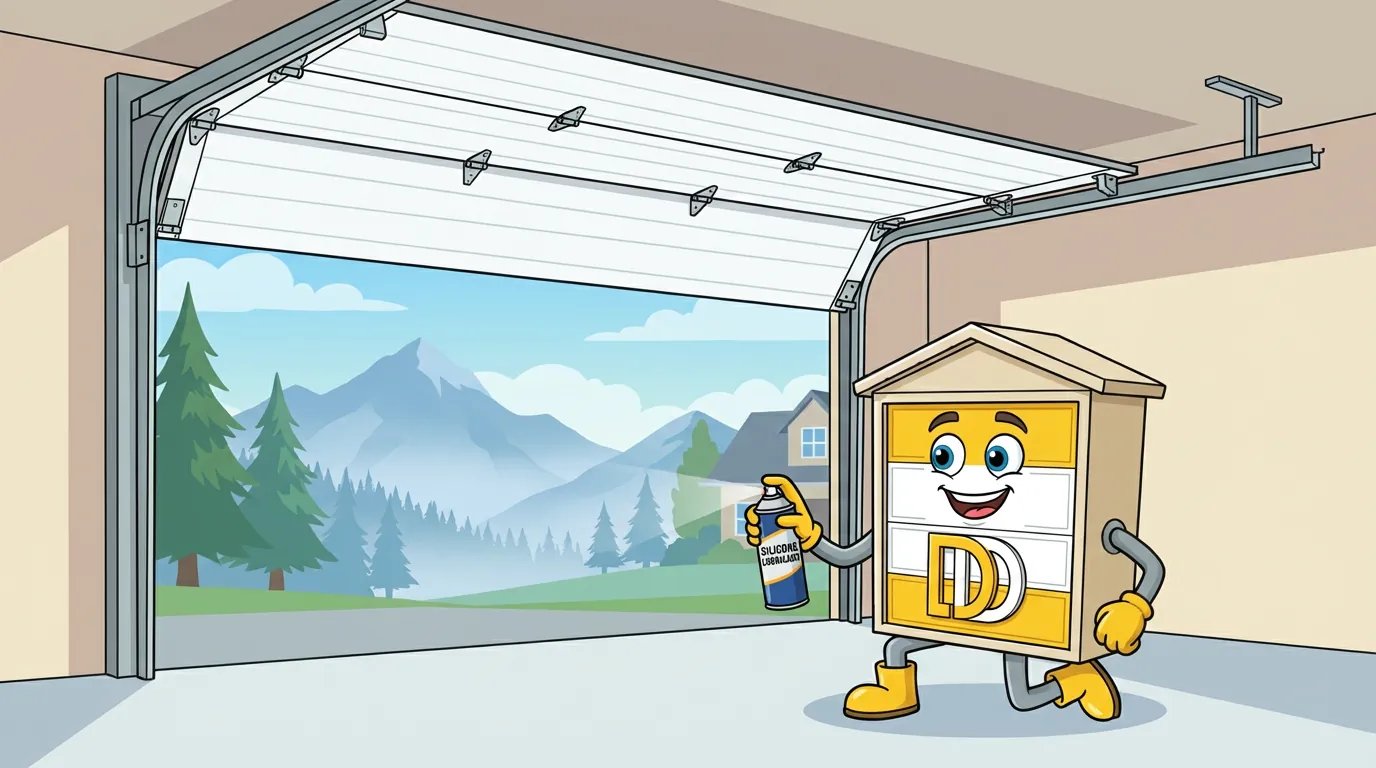
- Hinges. With the door fully closed, spray a light pass of silicone on each hinge pivot. Open and close the door once manually to work it in.
- Rollers. With the door partway open, spray silicone on the shaft of each roller where it enters the bracket. Give the door a half-cycle to distribute.
- Spring. Apply a thin film of white lithium grease along the length of the torsion spring using a rag, not your bare hand. Do not spray, do not pour.
- Bearing plates. A small dab of white lithium grease at each end of the spring, worked in with a finger.
- Lock and latches. A light squirt of silicone into any keyed cylinder, slide latch, or manual lock.
- Reconnect the opener. Run the door through two full cycles. It should be noticeably quieter.
Wipe drips off the face of the door before they dry.
Pitt Meadows Humidity: What Changes
Pitt Meadows sits in the eastern Fraser Valley. That means wetter springs and stickier summers than areas closer to the ocean, and two real implications for how you lubricate.
Water resistance matters more here
Silicone spray labeled “water resistant” or “marine grade” holds up through the surprise showers that happen well into late May. Standard lubricants wash off, especially on rollers near the bottom seal. It is worth the extra dollar.
Agricultural dust is abrasive
Homes near the dyke system and the blueberry farms pick up more fine dust and pollen than average. Once that grit lands on fresh lubricant, it becomes sandpaper on your hardware.
The fix: wipe each hinge and roller bracket clean BEFORE lubricating, not after. This keeps the grit out of the fresh grease instead of trapping it in.
Watch for rust on hinge pins
Any orange staining on a hinge pin means that hinge has been running dry for a while. The lubrication pass will quiet it, but note which hinges had rust. If it comes back within 6 months, the hinge pin is worn and should be replaced before it fails.
When Lubrication Will Not Fix It
Lubrication fixes noise caused by metal-on-metal contact. It does not fix worn parts.
Signs the problem is not lubrication:
- Door sags on one side after a full pass - that is a spring issue
- Door shudders or jerks through its travel - roller wear or track damage
- Loud “bang” at the top or bottom of the travel - spring or cable
- Door will not stay in the open position - opener calibration or spring tension
- New sound since last week - something just broke
When to stop DIY and call: if the full lubrication pass does not bring the quiet back, the noise is coming from something worn, not something dry. Replacing a single worn hinge or a pair of rollers on site is usually $80 to $180. Running to a serious spring failure a few weeks later is $350 to $600.
We handle garage door maintenance and spring and cable repair across Pitt Meadows and the rest of the Tri-Cities, usually same-day for standard calls.
Bottom Line
The spring lubrication pass is the highest-return 20 minutes you can spend on a garage door. Five points, two products, no tools, no skill required.
Your action list:
- Buy a can of silicone spray and a small tube of white lithium grease
- Pick a dry afternoon in the next two weeks
- Disconnect the opener, wipe the tracks, hit the 5 points in order
- Run two cycles and listen
- If it is still noisy, it is parts - not lube - and a service visit is the fastest fix
If you would rather hand the whole thing off, book a maintenance visit and we will do the full pass, a proper balance check, and replace anything that is past its life. About 45 minutes, most doors.