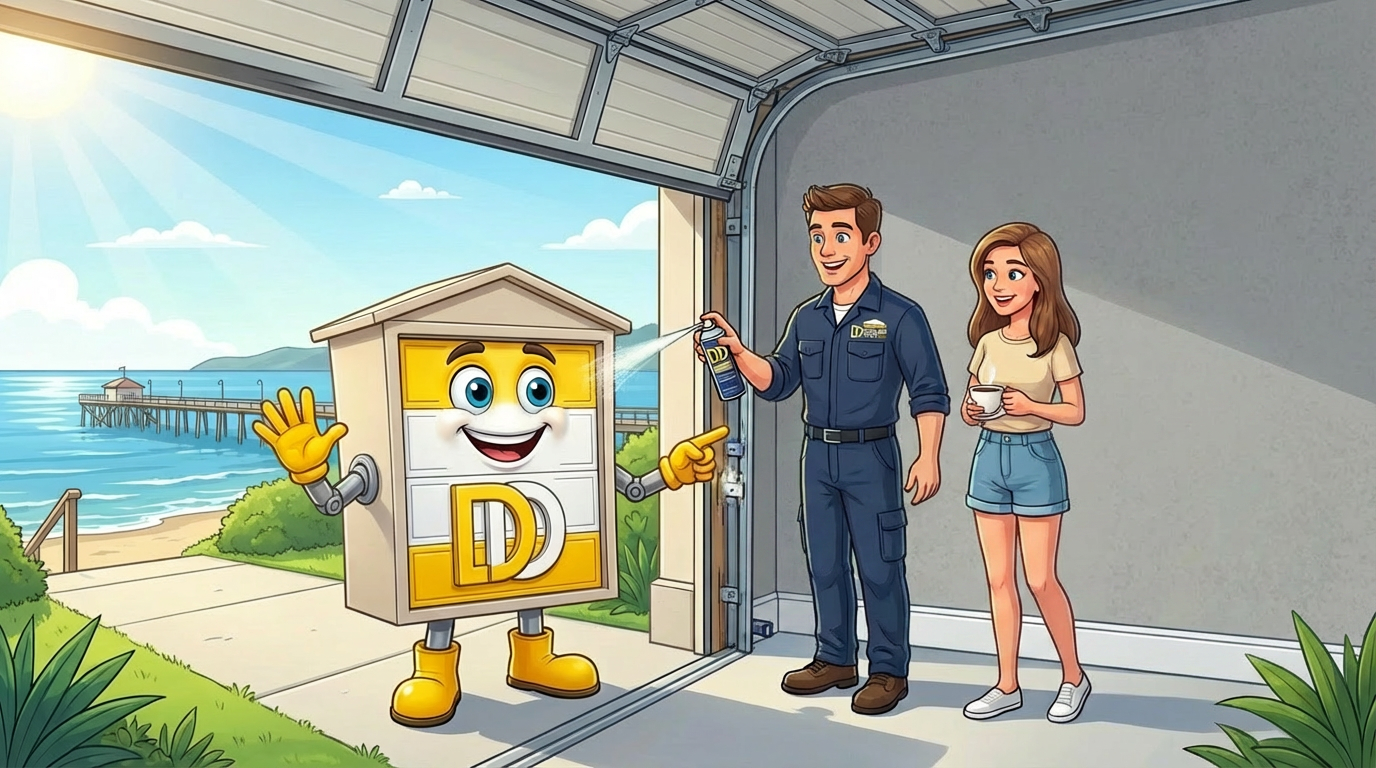
Ask five people how often you should lubricate a garage door and you’ll get five different answers, ranging from “once a year” to “whenever it squeaks.” For a home inland in Kelowna or Kamloops, once a year is fine. For a coastal White Rock home sitting a few hundred metres from the ocean, that schedule will leave your door dry, squeaky, and wearing out its rollers and springs years earlier than it should.
This post lays out the lubrication schedule we actually recommend for coastal homes in White Rock, South Surrey, Crescent Beach, and Ocean Park — which products to use, which ones to avoid at all costs, and what the difference looks like in the long run.
Why Coastal Climates Need More Frequent Lubrication
Three things strip lubricant from garage door components on BC’s coast faster than inland areas:
- Salt air. Even a few kilometres from the ocean, salt particles carry on the prevailing westerlies and deposit on exposed metal. Salt accelerates corrosion and breaks down grease over time.
- Humidity cycles. White Rock gets long wet spells followed by warm sunny stretches. Repeated wet-dry cycles cause lubricants to emulsify, wash off, or dry out.
- UV exposure. Surprisingly, coastal BC gets strong UV during the sunny summer months. UV breaks down petroleum-based greases and speeds their failure.
The combination means a coastal White Rock door that sees one annual lubrication is running “dry” for more than half the year. Dry parts squeak, wear faster, and put extra load on the opener — which then wears out faster too.
The Recommended Schedule
For a typical coastal White Rock home, we recommend the following schedule:
| Season | Action | Why |
|---|---|---|
| Early spring (March/April) | Full lubrication service | Recover from winter salt and wet exposure |
| Early fall (September/October) | Full lubrication service | Prepare for winter rain and temperature drops |
| Monthly | Quick visual check + listen for new noises | Catch small problems early |
| Every 2 years | Professional maintenance visit | Inspection of springs, cables, rollers, balance |
That’s twice-a-year DIY lubrication as a minimum, with a professional visit every second year for the parts you shouldn’t touch yourself.
Inland BC homes (Chilliwack, Abbotsford away from the river, Maple Ridge on the slopes away from drainage) can often get away with annual lubrication. Coastal homes within 5 km of the ocean should stick to twice a year.
What to Lubricate
Not every part of a garage door needs lubricant, and applying grease to the wrong places actively causes problems. Here’s what gets lubricated and what doesn’t.
Lubricate these:
- Hinges. Spray into each hinge joint where the panels meet. Open and close the door once to work it in.
- Roller bearings. This is the shaft the roller spins on, not the nylon wheel itself. A small shot into the bearing is plenty.
- Torsion spring. Apply a light, even coat along the full length of the spring. This is the single biggest difference-maker in noise and spring life.
- End bearing plates. At the two ends of the torsion spring, where the shaft passes through a bearing plate. A small shot into the bearing.
- Opener rail (chain and screw drives only). Wipe down first, then apply a thin coat along the rail.
- Lock mechanism. If you have a manual lock, the bar and striker benefit from a light spray.
Do NOT lubricate these:
- Tracks. The rollers need to roll, not slide. Lubricating tracks makes them attract dirt and causes rollers to skip. Clean the tracks with a damp cloth instead.
- Nylon rollers themselves. Only the bearing shaft, not the wheel surface.
- Belt drives. Modern belt-drive openers use a reinforced rubber belt that doesn’t need lubrication and can be damaged by solvents.
- Plastic parts. Many petroleum-based lubricants damage plastic. Check the label if you’re unsure.
What to Use
The right product matters more than how often you apply it.
Our top pick: 3-IN-ONE Professional Garage Door Lubricant — a silicone-based spray designed specifically for garage doors. It’s the product we use on our own service calls. Around $12–$15 at any Canadian Tire, Home Depot, or Lowe’s.
Also excellent: White lithium grease in a spray can — Works great on hinges and springs. Slightly messier than silicone but longer-lasting. $10–$14.
Acceptable for DIY: Silicone spray (general purpose) — Works, though it doesn’t last quite as long as a dedicated garage door formulation. Around $8.
What NOT to Use
Never use WD-40. This is the biggest single mistake we see on service calls. WD-40 is a solvent and water-displacer, not a lubricant. It will:
- Strip the existing grease from your springs and bearings
- Leave a thin residue that attracts dust
- Evaporate within days, leaving parts drier than before you started
If your springs are squealing, they need grease, not a solvent. Using WD-40 is the equivalent of “cleaning” your chain with gasoline — you’ll remove the lubrication and make the problem worse.
Also avoid: motor oil (too thick and messy), cooking oil (goes rancid), petroleum jelly (collects dirt), and automotive grease that isn’t rated for high-cycle applications.
How to Lubricate: 15-Minute Process
Once you have the right product, the actual application is fast.
- Close the door. Start with the door fully closed so you can reach everything safely.
- Disconnect the opener. Pull the red emergency release cord. You don’t need to move the door manually, but disconnecting prevents accidental cycling.
- Wipe down the tracks with a damp cloth. Remove grit, salt deposits, and debris.
- Spray each hinge. One short shot into each joint. Don’t soak it.
- Spray each roller bearing. Aim at the shaft, not the wheel.
- Coat the torsion spring. Apply a light, even pass along the full length. Use less than you think.
- Hit the end bearing plates. A small shot at each end.
- Lubricate the opener rail if it’s a chain or screw drive.
- Wipe away excess. Any drip you see on the door, panels, or walls should be wiped.
- Reconnect the opener and cycle the door 3–4 times to distribute the lubricant evenly.
Total time: 10–15 minutes. That’s the entire twice-yearly maintenance routine for most White Rock homeowners.
Signs You’re Overdue
Even if you’re tracking the calendar, watch for these telltale signs that your coastal door is running dry before the next scheduled lubrication:
- New squeaking or squealing during operation
- Popping or cracking from the spring as the door opens
- Visible rust on the spring coils
- Increased opener strain or slower operation
- Rollers visibly hesitating or wobbling in the track
Any of these means lubrication is overdue, no matter what the calendar says.
Bottom Line
Twice a year — spring and fall — with a proper garage door lubricant, and your coastal White Rock door will last 20 years or more with almost no other intervention. Skip the WD-40. Don’t lubricate the tracks. And if the door starts making new noises, handle it before it becomes a $300 repair.
If your door has been running dry for a while and you’re not sure what the damage looks like, we offer flat-rate garage door maintenance visits across White Rock, South Surrey, and the Peninsula area. Book a visit and we’ll do the full service: clean, inspect, lubricate, balance test, and safety check. If inspection reveals worn springs, we also handle spring and cable repair same day.