Your garage door comes down, touches the floor, and immediately springs back up. Every time.
Frustrating, right? It is also a real security problem. The garage never actually stays closed.
The good news: this exact symptom has about six common causes, and almost all of them are fixable without a technician. The bad news: they have to be checked in a specific order. Start in the wrong place and you will waste an hour.
This guide walks through the diagnostic path we use on every call in Port Coquitlam - in the order that actually gets to the fix fastest.
Why the Door Reverses in the First Place
Every modern garage door has a federally mandated safety reversal system. During a close cycle, the opener is measuring three things at once:
- The photo-eye beam at the bottom of the door (is it broken?)
- The close-force the motor is drawing (above the threshold?)
- The travel distance (did the door hit something unexpected?)
If any of those trip, the opener reverses. Instantly.
Why this matters: that system is what stops your door from closing on a child, a pet, or a bike left in the doorway. It is doing its job. The “reverses immediately” symptom means something in the environment is tripping it when it should not. Our job is to find what.
The 6 Most Common Causes (Ranked by Frequency)
We ranked these by how often we find each one on actual Port Coquitlam service calls.
| # | Cause | Likelihood | Typical fix | DIY? |
|---|---|---|---|---|
| 1 | Misaligned or dirty photo-eye sensor | Very common | Clean lenses, re-align brackets | Yes |
| 2 | Obstruction on the floor or bottom seal | Very common | Remove debris, inspect seal | Yes |
| 3 | Close-force set too sensitive | Common | Adjust close-force screw | Yes |
| 4 | Worn or torn bottom seal | Common | Replace rubber seal | Yes |
| 5 | Down-travel limit set incorrectly | Occasional | Adjust down-limit screw | Yes |
| 6 | Failing logic board or damaged wiring | Rare | Board swap / opener replacement | Technician |
Start at the top and work down. Roughly 80% of the time the fix is in rows 1 or 2, and takes under 5 minutes.
Do NOT start by adjusting force or limit screws. Fiddling with those when the real issue is a dirty sensor just hides the symptom temporarily and makes it harder to diagnose later.
The 20-Minute Diagnostic
You need: a clean dry cloth and maybe a small Phillips screwdriver. That is it.
Step 1: Check the Photo-Eyes
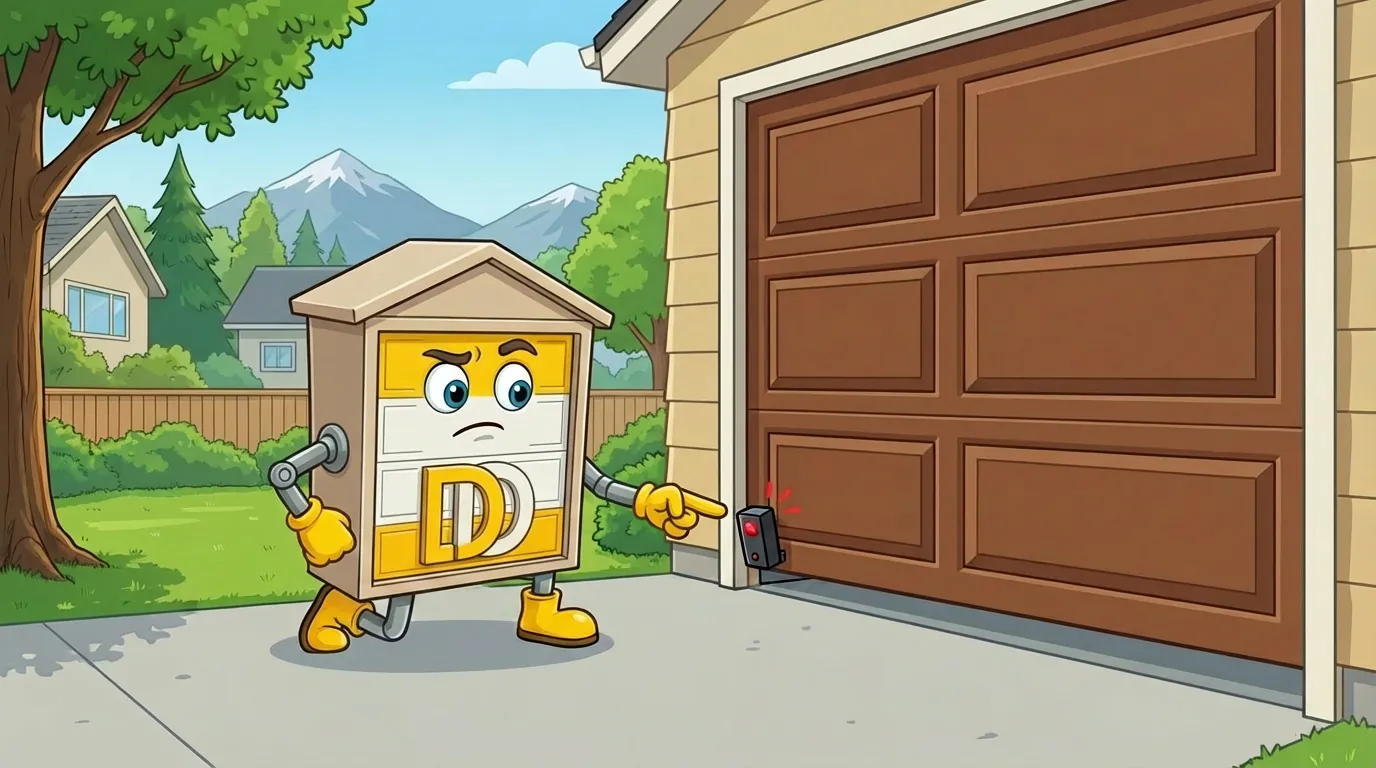
The two small sensors on either side of the door opening, about 6 inches off the floor. Each has an LED that should show solid light.
- Solid LED on both sides - eyes are fine, move to Step 2
- Flickering, dim, or off LED - eyes are the problem
What to do:
- Wipe both lenses with a clean dry cloth
- Look down the beam path for anything breaking it (leaf, toy, spider web)
- If a lens is still off, loosen the bracket screw, aim the sensor at its partner, re-tighten when the LED comes solid
This fixes the problem about half the time on its own.
Step 2: Walk the Floor Path
Look down the length of the door’s close path for anything it might be closing onto.
Common culprits in Port Coquitlam homes:
- Small debris or leaves blown in from an April wind
- A toy, shoe, or sports equipment left in the doorway
- A warped floor tile or a concrete high spot (especially in older homes)
- A puddle from yesterday’s rain (yes, really - the opener can read standing water as resistance)
If you find something, clear it and test the door again.
Step 3: Inspect the Bottom Seal
The rubber gasket along the bottom of the door. Lift it slightly and look underneath.
Signs of a bad seal:
- Tears or visible splits in the rubber
- A section folded under the door (very common)
- Compressed flat with no springiness
- Separating from the metal retainer
A replacement bottom seal runs $30 to $60 at any BC hardware store and takes about 15 minutes to swap. If the seal is obviously damaged, replace it before continuing.
Step 4: Test the Close-Force
With the door closing, push up on it lightly at about waist height.
- Door reverses with almost no pressure - close-force is too sensitive
- Door keeps going under light pressure - force is fine, skip this step
The adjustment:
- Most openers have a small screw or dial on the back labeled “Close Force” or “Down Force”
- Turn it clockwise a quarter-turn
- Run a close cycle and test again
- Repeat in quarter-turns until the door closes cleanly
Heads up: if you have turned the screw several full rotations without improvement, the problem is not force-related. Stop adjusting and move on - otherwise you are masking a real issue.
Step 5: Check the Down-Travel Limit
If the opener is trying to drive the door past where it physically stops, it will register as an obstruction on normal contact.
- The down-limit screw is usually on the same face as the force screw, labeled “Down Limit” or “Close Limit”
- Turn it counter-clockwise in small increments to shorten the close travel
- Test after each adjustment
Most limit issues show up as “the door slams into the floor” rather than “reverses gently” - so this is usually not the fix, but it is worth checking.
When It Is Time to Call
If you have worked through all 5 DIY steps and the door still reverses, the cause is inside the opener rather than on the door. That is diagnostic territory and takes tools you do not have.
The two most common technician-only causes:
- Failing logic board. Uncommon but real, especially on openers over 10 years old. In Port Coquitlam we see this most on units installed in the early 2010s that have lived through a few power surges. Diagnostic is 30 minutes on site.
- Damaged low-voltage wiring to the photo-eyes. The eyes look clean, the lenses are fine, but the receiver LED still will not come on. That usually means the wire has been damaged somewhere along its run - weed trimmers, soccer balls, and occasionally rodents are the usual suspects.
Typical fixes:
| Fix | Cost range |
|---|---|
| Logic board swap | $200-$350 + labour |
| Full opener replacement (standard residential) | $500-$900 installed |
| Re-run low-voltage wire to photo-eyes | $80-$150 labour |
We handle garage door opener troubleshooting and garage door repair across Port Coquitlam and the rest of the Tri-Cities, usually same-day for calls placed before noon.
Bottom Line
A door that reverses on contact has 6 common causes and a clear diagnostic order. Photo-eyes first, floor and seal second, force and limit after that. Four out of five times the fix takes under 5 minutes and costs nothing.
Your action list:
- Wipe and re-align the photo-eyes
- Walk the floor path and clear anything in the way
- Inspect the bottom seal for damage
- Test and adjust close-force if needed
- Check down-travel limit as a last DIY step
- If the door still reverses, stop adjusting and call
If you would rather skip the diagnostic and have it fixed on the first visit, book a service call and we will run the full sequence and resolve it on site.