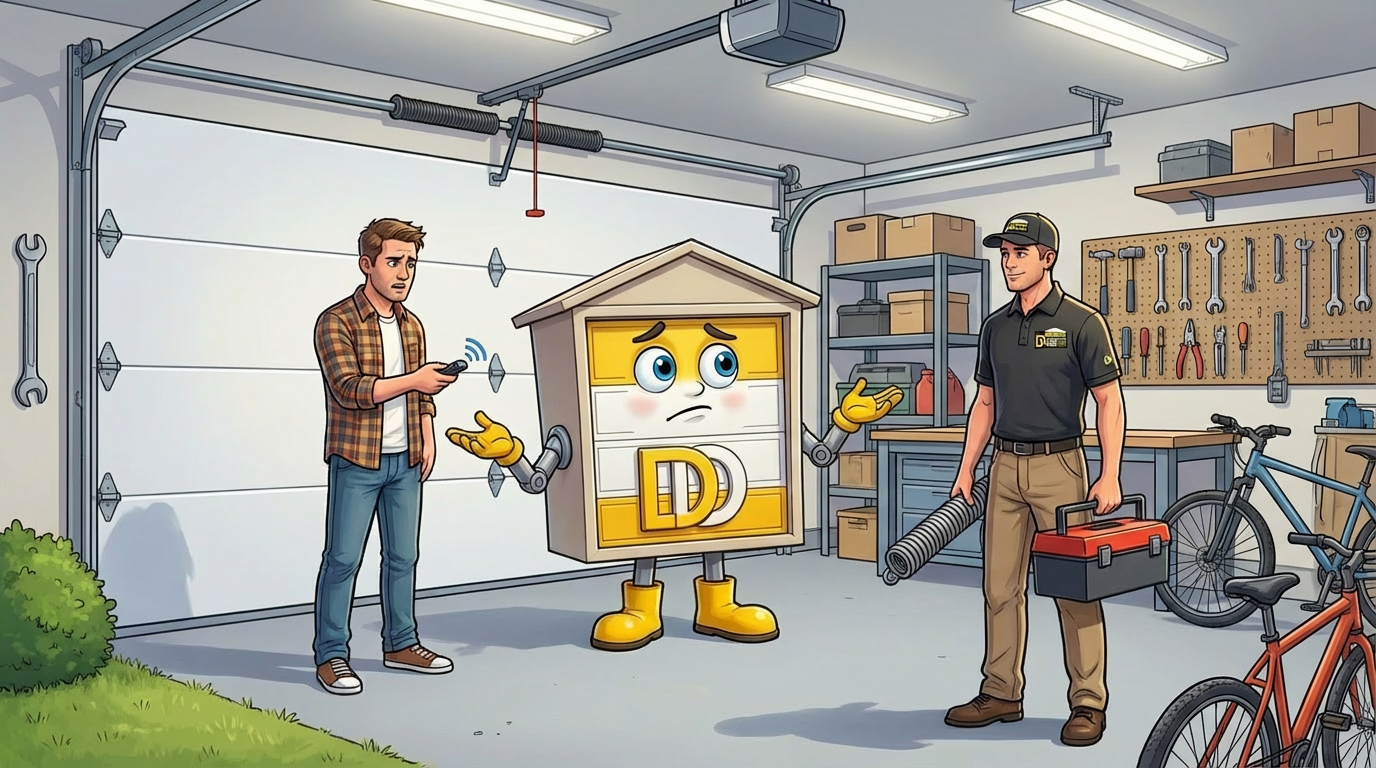
You hit the button. The opener clicks, maybe hums or whirs for a second, but the door doesn’t actually move. This is one of the most frustrating failure modes because it feels like “everything is working” — you hear the motor try — but nothing happens. The good news is that this specific symptom usually points to one of six causes, and most of them are cheap to fix. The bad news is that one of them is a snapped torsion spring, which is a genuine safety issue.
This post walks through what’s happening when an opener clicks without moving the door, how to work out which cause you’re dealing with, and which fixes are safe to do yourself on your Langley, Walnut Grove, or Willoughby home.
What the Clicking Actually Means
A garage door opener’s motor is not strong. It’s designed to assist a properly balanced door that’s being lifted almost entirely by the torsion spring overhead. When you hear clicking but see no movement, one of three things is happening:
- The opener is trying to move the door but something mechanical is stopping it.
- The opener is running but is disconnected from the door (physically or via the emergency release).
- The opener is sending a command but the motor or drive mechanism has failed.
The specific sound can actually tell you a lot. Short single clicks, rapid clicking, a grinding hum, and a brief whir then silence all point to different causes.
1. The Torsion Spring Is Broken
This is the most common cause, and it’s the one that’s actually urgent. When a torsion spring snaps, the opener no longer has help lifting the door. A typical 16-foot double door weighs 300–400 pounds, and a half-horsepower opener is maybe rated to lift 50 pounds on its own. So it strains, clicks, maybe hums for a second, and gives up.
How to check:
- Disconnect the opener with the red emergency release cord.
- Try to lift the door manually.
- Does it feel extremely heavy? Can you barely budge it?
- Look at the spring above the door. Is there a visible gap in the middle where it appears to have snapped? Two coils instead of one continuous spring?
Fix: This is a technician call. Do not attempt torsion spring replacement yourself. A torsion spring stores enough mechanical energy to cause serious injury. Typical replacement cost in Langley: $200–$400 depending on spring size and door weight.
A broken spring is the most common reason for this symptom, and unfortunately, it’s also one of the most dangerous to ignore or try to work around.
2. The Opener Is Disconnected from the Door
The red cord hanging from the opener trolley is an emergency release. It detaches the door from the opener mechanism so you can operate the door manually during a power outage. If someone has pulled that cord (or it’s been pulled accidentally), the opener will run but the door will sit still because they’re no longer physically connected.
How to check: Look at the trolley on the opener rail. Is it in the position where the lift arm connects to the door? Or is it sitting free, disconnected? Pull the red cord toward the door and then operate the opener — the trolley should re-engage with a click.
Fix: Pull the emergency release cord toward the door (not down, which is the disengage direction). Cycle the opener once. The trolley should re-lock onto the lift arm. Takes 30 seconds. If you’re not sure which direction is which, the opener housing or manual usually labels it.
3. The Lift Arm Has Separated from the Bracket
Similar to the emergency release issue, but mechanical rather than manual. Over time, the pin, bolt, or clip that connects the opener’s lift arm to the bracket on the door can wear out, snap, or back out. The arm swings free, the opener moves, but nothing happens to the door.
How to check: With the opener running (briefly), watch the trolley and the lift arm. Is the arm moving but the door not? Does the arm dangle or swing freely at the door end?
Fix: Reattach the lift arm. If the pin or bolt is missing, it’s a $5 part at any hardware store — just match the diameter. If the lift arm itself is bent or broken, it’s a $40–$80 replacement. This is a DIY fix for most people.
4. The Drive Mechanism Has Failed
Inside the opener, a chain, screw, or belt connects the motor to the trolley that actually moves the door. If that drive mechanism breaks — a chain has popped off its sprocket, a screw has stripped its coupling, a belt has snapped — the motor runs but the trolley doesn’t move.
How to check: Remove the cover from the opener (or look at it from below with the opener motor housing lit up). Do you see a broken chain, a bent screw drive, or a broken belt? Does the trolley on the rail move when you briefly activate the opener?
Fix: Depends on what’s broken.
- Chain off its sprocket: Reset it by hand, tension properly. DIY-friendly.
- Broken chain: Replaceable, but the length has to match exactly. Technician fix unless you’re experienced.
- Stripped screw drive: Usually means a new screw and coupling. Technician fix.
- Broken belt: Belt replacement. Technician fix for most homeowners.
5. The Motor Has Failed
On older openers — say, 12 years and up — the motor can burn out while the logic board and lights still work. You’ll hear a click or hum as the motor tries to start, then silence. Sometimes you’ll smell burnt electrical insulation.
How to check: Listen carefully when you press the button. Do you hear a brief electrical hum that cuts out immediately? Any smell of burning? Does the opener light come on but nothing else happens?
Fix: If it’s an older opener (10+ years), replace it. Motor replacement parts are usually more expensive than a new opener, and you’re paying to keep old electronics running. A new belt-drive opener installed runs $550–$900, which is typically less than the repair on a 12-year-old unit.
6. Capacitor Failure
A capacitor is a component inside the opener that helps start the motor. When it fails, the opener hums or clicks but the motor can’t generate enough torque to start rotating. This is especially common on older screw-drive openers.
How to check: Does the opener hum for about a second and then give up, with no movement? Is the opener 8+ years old? Have you recently had a power surge or nearby lightning storm?
Fix: A capacitor is a cheap part ($10–$30), but replacing it requires opening the opener housing and working around mains voltage. We’d call this a technician fix unless you’re comfortable with electrical repairs.
Quick Symptom → Cause Reference
| What you hear | Most likely cause | DIY? |
|---|---|---|
| Short click, nothing else | Logic board or motor start failure | No |
| Click plus brief hum, then stops | Broken torsion spring or bad capacitor | No |
| Motor runs, trolley doesn’t move | Drive mechanism failure or emergency release | Sometimes |
| Motor runs, trolley moves, door doesn’t | Lift arm disconnected | Yes |
| Grinding and clicking | Worn drive gear | Technician |
| Single loud bang then clicking | Torsion spring snapped | No — technician urgent |
When to Stop and Call a Professional
Some of these fixes are genuinely simple. Others involve a 300-pound door being held up by a 300-pound torsion spring that you absolutely should not be touching without specialized tools. Call a technician if:
- You suspect the torsion spring is broken
- You see any rust, fraying, or damage on the lift cables
- The door feels extremely heavy when disconnected from the opener
- The opener is visibly old and the motor has stopped working
- You’ve worked through the diagnostic list and you’re not sure what you’re dealing with
In Langley specifically, we see a seasonal spike in broken torsion springs every spring — winter temperature cycles stress the metal and they tend to snap right around April and May. If your door was fine in March and suddenly won’t open in May, that’s almost certainly your answer.
Bottom Line
Clicking without movement is actually one of the clearer symptoms to diagnose. Run through the list in order: check the emergency release, check the lift arm, look for a snapped spring, and listen to what the motor is doing. Most calls we get for this symptom resolve in under an hour once we’re on site, and about half of them could have been diagnosed over the phone with the right questions.
If your diagnosis points to anything involving the torsion spring, cables, or motor, we handle garage door repair, spring and cable repair, and garage door opener service same-day across Langley, Walnut Grove, Willoughby, Brookswood, and the rest of the Fraser Valley. Book a service call or phone us 24/7 for emergency service.