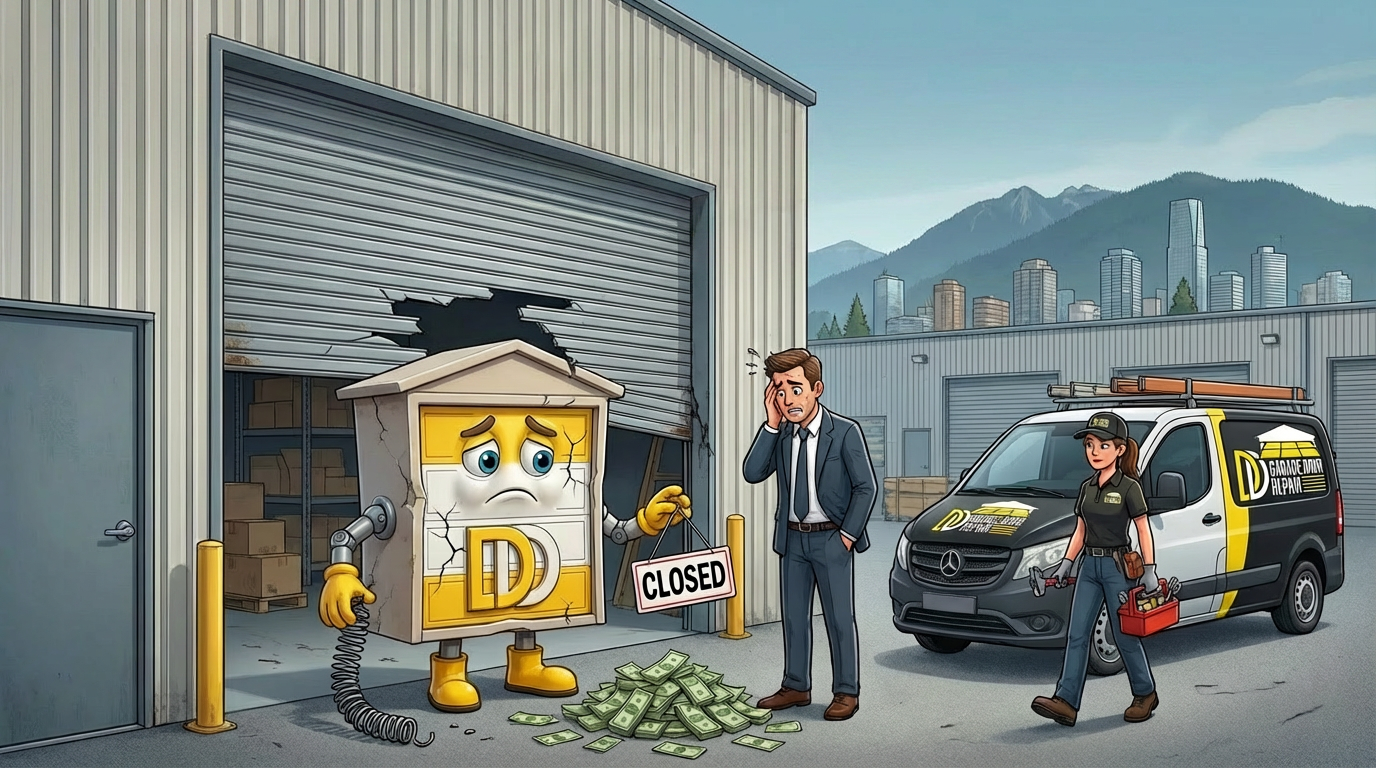
If you operate a warehouse, shop, auto bay, or distribution centre in Burnaby’s Big Bend or Lake City industrial areas, you already know that a stuck commercial garage door is not a small problem. It stops trucks. It stops inventory. It stops the people you’re paying by the hour. And yet, most business owners we talk to have never actually put a number on what a single hour of downtime costs them — which makes it very hard to justify the preventive maintenance that would prevent 80% of those emergencies in the first place.
This post walks through the real, hard-dollar cost of commercial garage door downtime for a typical Burnaby business, breaks the numbers down by business type, and gives you a way to calculate your own exposure. If you own or operate a facility along Marine Way, Sperling, or Still Creek, the math is probably worse than you think.
Why Most Business Owners Underestimate Downtime Cost
When a commercial door fails mid-day, the obvious cost is the repair itself — the technician call, parts, maybe an after-hours surcharge. That number is usually somewhere between $400 and $1,500 depending on what broke and when.
The much bigger number is everything that happens while the door is down:
- Trucks idling in the loading zone, unable to deliver
- Staff standing around waiting for access
- Product sitting at the wrong temperature
- Customers turned away
- Overtime to catch up on missed shipments
- Insurance implications if the site is exposed
A good rule of thumb from our commercial service calls in Burnaby: the repair bill is roughly 20% of the total cost of an unplanned outage. The other 80% is hidden in payroll, lost revenue, and delay cascades.
Direct Costs of an Unplanned Outage
Let’s start with the costs that show up on a receipt.
| Direct cost | Typical range |
|---|---|
| Emergency service call | $150–$350 |
| After-hours / weekend surcharge | $100–$300 |
| Parts (springs, cables, rollers, opener) | $150–$1,200 |
| Replacement commercial opener | $800–$2,500 |
| Full sectional door replacement | $3,500–$12,000 |
A routine weekday failure with a broken torsion spring will cost around $450 to $750 including parts. A Sunday afternoon failure with a seized opener and a broken cable can easily run over $1,800 before you factor in any downstream impact.
Indirect Costs: Where the Real Damage Lives
The indirect costs depend heavily on what your business actually does. Here’s a table of typical hourly downtime exposure by sector, based on real conversations with Burnaby facility managers.
| Business type | Est. lost revenue per hour | Payroll cost (idle staff) | Other impact |
|---|---|---|---|
| Auto body shop (3 bays) | $400–$700 | $120–$180 | Customer reschedules, rental car bills |
| Distribution warehouse | $800–$1,600 | $250–$500 | Delivery penalty clauses, late fees |
| Cold storage facility | $1,000–$3,000 | $200–$400 | Temperature excursion → product loss |
| Auto dealership | $300–$600 | $150–$250 | Lost service bay revenue, customer wait |
| Commercial bakery | $500–$1,200 | $200–$350 | Missed production runs, spoilage |
| Car wash | $200–$500 | $80–$150 | Walk-away customers, refund pressure |
A single four-hour failure at a mid-sized Burnaby distribution warehouse, spanning the afternoon dispatch window, realistically costs:
- $1,200 lost dispatch revenue
- $1,500 idle payroll (driver + warehouse + admin)
- $550 emergency service and parts
- $400 late-delivery penalty from one contract
- Total: ~$3,650
That’s one door failure. Now consider that most of these failures happen to doors that haven’t seen a maintenance technician in 18 months or more.
The Preventive Math
A commercial maintenance agreement in Burnaby — typically two scheduled visits per year — runs $400 to $900 per door depending on size and cycles. Each visit includes spring inspection, cable check, lubrication, photo-eye testing, balance test, track alignment, and opener diagnostics.
Let’s do the math over a three-year window on a single high-use commercial door:
| Scenario | 3-year cost |
|---|---|
| Scheduled maintenance (2 visits/year) | $2,400–$5,400 |
| One unplanned failure + 4 hours downtime | $3,500–$6,000+ |
| Two unplanned failures + 8 hours total | $7,000–$12,000+ |
Preventive maintenance pays for itself the first time it prevents an emergency. And in our experience across the Lower Mainland, a door on a regular service schedule has roughly 80% fewer unplanned failures than one that runs until something breaks.
A Composite Example from Big Bend
We were called out to a refrigerated distribution centre in Big Bend last year. Two overhead doors had never been serviced since install — six years earlier. Both sets of torsion springs were at end of life, one cable was frayed, rollers were worn, and the photo-eye on dock 2 had been bypassed with a zip tie (a separate safety concern).
Door 1 failed on a Thursday afternoon at 2 PM. We got there at 3:15. Door was back up by 5:45. Meanwhile:
- Two trucks diverted to a secondary dock
- One refrigerated trailer held temperature for 90 minutes, then the driver had to idle for cooling
- Dock crew of four stood down for two hours
- One outbound delivery missed a scheduled window, triggering a $300 penalty
Repair bill: $780. Indirect cost: estimated $2,400+. The whole event could have been prevented by a $350 spring inspection three months earlier.
After that call, they put all six of their commercial doors on a twice-a-year service schedule. They haven’t had an emergency since.
How to Calculate Your Own Downtime Exposure
If you’re not sure what a door failure actually costs you, run this quick back-of-envelope calculation:
- Revenue impact per hour. What’s your shop’s average hourly revenue during peak hours? (Divide daily revenue by hours open.)
- Payroll impact per hour. Total wages of the staff who can’t do their job without that door working, times their hourly rate.
- Realistic outage duration. For a same-day repair on a weekday, plan on 3 to 5 hours. For evening or weekend, 6 to 12 hours.
- Multiply and add. (Revenue impact + payroll) × outage hours + $800 average repair bill.
Most Burnaby businesses land somewhere between $1,500 and $5,000 per failure. If your number is higher, a maintenance agreement is a rounding error compared to your downside exposure.
Bottom Line
Commercial garage doors don’t announce their problems. They seize, snap, or jam at the worst possible moment — usually under full load and usually on a day when you can least afford it. The cost isn’t the repair bill; it’s everything that stops happening around the outage.
If your commercial door hasn’t been inspected in the last 12 months, now is the time. We service commercial garage doors across Burnaby, New Westminster, and the rest of the Lower Mainland, with scheduled maintenance plans and 24/7 emergency response. Get a commercial quote and we’ll put together a plan based on your cycle count and risk tolerance.