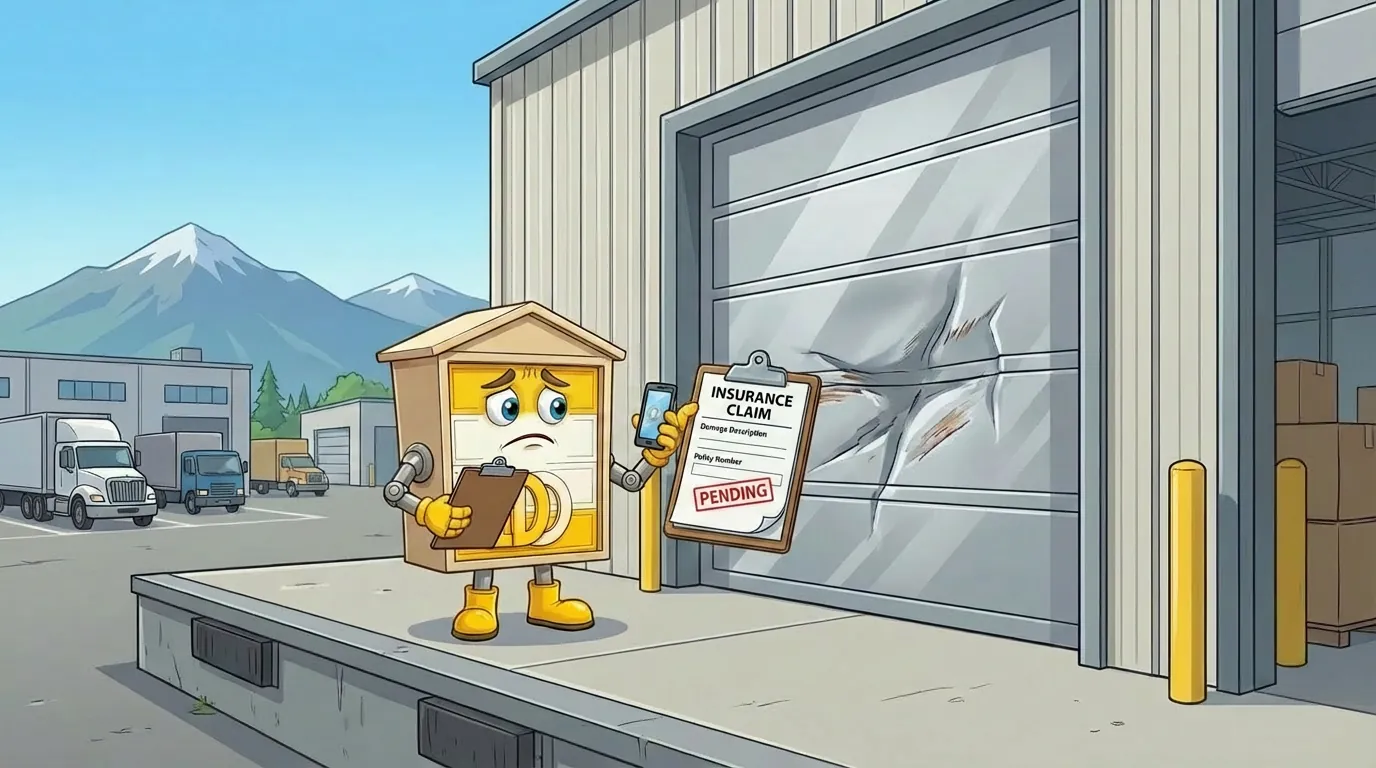
A delivery truck backs into your commercial garage door. Or a forklift clips the bottom panel. Or a May windstorm peels back the top section while the door was open.
Now the repair is the easy part. The insurance side is where Abbotsford business owners burn the most hours.
We handle commercial door damage calls across Abbotsford year-round, and the pattern is predictable: the claim gets paid faster, gets denied, or gets partially covered based almost entirely on what happens in the first 24 hours after the damage. Documentation is everything.
This guide covers:
- What’s typically covered on a commercial property policy
- What’s usually excluded as wear-and-tear
- The documentation checklist that gets claims paid without back-and-forth
- Timeline expectations from damage to door installed
- When to call your insurer vs. just paying out of pocket
What Commercial Policies Typically Cover
Most commercial property insurance policies in BC cover garage door damage under one of three sections: building coverage, business personal property, or commercial vehicle liability, depending on who hit what.
Typically covered:
- Impact damage from a vehicle (yours or a third party’s)
- Windstorm or weather damage (wind-speed thresholds vary by policy)
- Vandalism or attempted break-in damage
- Damage caused by building settlement or structural shift
- Fire, smoke, or adjacent-fire damage
Typically excluded (check your specific policy):
- Wear and tear or progressive deterioration
- Damage from rust or corrosion (unless caused by a covered peril)
- Mechanical breakdown of the opener or springs
- Damage from rodents, insects, or pest activity
- Damage from overloading the door (hanging things from it, etc.)
The single most common denial we see on commercial doors is “wear and tear.” If a spring snapped or a cable frayed through normal use, insurance will not cover it. If the spring snapped because a forklift hit the header and shifted the alignment, that can be covered as impact damage.
The First 24 Hours: Documentation Checklist
When a commercial door takes damage, the documentation you gather in the first day usually determines whether the claim is paid in full, paid partially, or denied.
Photograph everything, twice
Take photos:
- Wide shot of the full door and surrounding area
- Medium shot of the damaged section
- Close-up of each specific point of damage (dents, bends, breaks)
- Interior shots showing the track, springs, and hardware
- Context shots showing the vehicle, equipment, or cause of damage (if visible)
Photo twice means once in daylight if possible, and once with the damage highlighted with chalk, tape, or arrows drawn on a printout. Insurance adjusters skim 20 photos per case; the highlighted ones get noticed.
File an incident report
If the damage was caused by an employee, a contractor, a delivery driver, or a third party:
- Who was operating the equipment
- Time, date, and location
- Witness names if any
- Any statements made at the scene
- Vehicle plate and company info if a third party
This goes in a written incident report filed within 24 hours. Most commercial policies require this for coverage.
Get a professional assessment
A written assessment from a commercial garage door company is worth more to an adjuster than a phone quote.
What an adjuster wants to see:
| Document | What it proves |
|---|---|
| Dated site visit report | Damage existed on a specific date |
| Itemized repair or replacement quote | True cost of remediation |
| Photo documentation by technician | Independent verification of damage |
| Description of cause (impact, wear, etc.) | Whether damage is covered under policy |
| Repair vs. replace recommendation | Minimum necessary to restore function |
Most commercial insurance policies require at least one professional assessment before approving a claim over $1,500. We produce these assessments as a standard part of a commercial site visit, at no charge if we end up doing the repair.
Abbotsford Specifics: The Damage Patterns We See Most
Valley windstorm damage
Abbotsford sits in the Fraser Valley, which means sustained winds from east-west corridors several times a year. Wind damage to commercial doors usually falls into two categories:
- Door was closed and wind load bent a panel - often covered if wind speeds exceeded the policy threshold (usually 50 km/h sustained)
- Door was open and the wind slammed it - often NOT covered unless you can document that the opening was for active business use
Tip: most commercial doors in Abbotsford that see wind damage were left open past business hours. Keep doors closed when not in active use; it saves a policy dispute every few years.
Forklift and pallet jack contact
The single most common commercial door damage call we get. A forklift tine catches the bottom of the door, a pallet jack runs into the lower panel, or a truck tailgate scrapes the top.
These are almost always covered under either your property policy (if your own equipment) or the operator’s liability (if a third party), but the claim requires:
- Incident report filed same-day
- Operator identification
- Photos before equipment is moved
Agricultural operations
Abbotsford’s agricultural sector means commercial doors on farms, greenhouses, packing facilities, and ag-service businesses. These take more wear than standard warehouse doors, and the “wear and tear” exclusion hits them harder.
If you are in ag operations:
- Schedule at least annual preventive maintenance (documented with invoices)
- Keep cycle counts on high-use doors
- Photograph the doors every spring in good condition
Documentation of regular maintenance shifts the wear-vs-damage argument in your favour when a claim is disputed.
Timeline: Damage to Door Installed
Realistic commercial door claim timeline for Abbotsford:
| Step | Typical timeline |
|---|---|
| Same-day temporary repair (secure the opening) | 2-4 hours from call |
| Professional damage assessment | 1-2 business days |
| Insurance adjuster visit | 3-10 business days |
| Claim approval | 1-3 weeks |
| Replacement door ordered (standard) | 1-2 weeks lead time |
| Custom size / commercial spec | 3-6 weeks lead time |
| Installation | 1-3 days once on site |
Total realistic timeline: 3 to 4 weeks for standard damage, 8 to 10 weeks for custom replacement.
During the interim, we can install a temporary cover or working door (rented) so your operation stays running. That temporary install is usually covered under “additional expenses” on a commercial policy if you document it.
When to Skip the Claim
Sometimes it makes sense to pay out of pocket rather than file.
Consider paying direct if:
- Total damage is under your deductible (usually $1,000 to $5,000 commercial)
- You have filed claims in the last 18 months and a new claim could affect renewal
- The damage is primarily cosmetic (small dent, scuff on paint)
- The cause might trigger a coverage dispute (wear vs. impact)
File the claim if:
- Damage is clearly impact or weather-related and over your deductible
- Door needs replacement rather than repair
- There is injury risk or business disruption exposure
- Third-party liability is involved (they hit your door)
Bottom Line
Commercial garage door claims are paid, denied, or disputed based on documentation. The repair itself is usually straightforward. The paperwork is the hard part.
Your commercial door incident response:
- Photograph the damage (wide, medium, close, context)
- File an incident report within 24 hours
- Get a professional assessment within 48 hours
- Secure the opening with a temporary cover if needed
- Decide whether to file based on deductible and claims history
- Track every expense related to the incident
We handle commercial garage door repair, replacement, and documented damage assessments across Abbotsford and the Fraser Valley. Same-day emergency response for damage that leaves your operation exposed.
If you are dealing with damage now, call us for an on-site assessment, temporary securing, and a written report that gets your claim moving.